EDHEC Climate Institute September 2026 Insights
Climate Risk, Adaptation and Resilience: From Science to Action |
| Forward to a colleague |
|
Subscribe to our newsletter |
 |
The EDHEC Climate Institute (ECI) supports finance professionals and decision-makers in navigating the challenges of climate change through cutting-edge research and practical tools. Our work focuses on six key areas: Physical Risks, Transition Risks, Resilience & Transition Technologies, Climate Scenarios, Green Assets, and Climate Regulation & Policies.
|
|
|
|
Feature
Doing More with Less: How Infrastructure Investors Can Focus on the Climate Strategies that Really Work
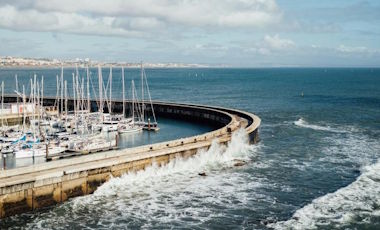
Drawing on the ClimaTech 2050 Project, this article examines how infrastructure investors can focus on climate strategies that really work. As the sector faces both significant emissions and growing physical climate risks, its response remains uneven, with some widely deployed measures delivering little meaningful carbon reduction. By mapping more than 100 decarbonisation and resilience strategies across 101 infrastructure asset subclasses according to their effectiveness and frequency of use, the analysis identifies four distinct clusters. It highlights the need to scale proven, widely applicable solutions while directing greater attention and capital towards high-impact, asset-specific strategies that remain underused.
|
|
Interview
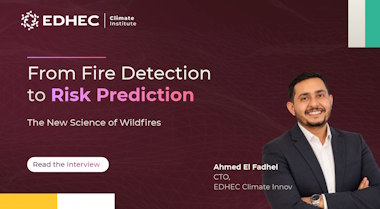
From Fire Detection to Risk Prediction: The New Science of Wildfires
This interview with Ahmed El Fadhel, CTO, EDHEC Climate Innov, examines how advances in satellite observation, physical modelling and AI are transforming wildfire-risk assessment as climate change alters where and how fires occur. It explains how SecuFire Action combines vegetation, topography and weather data with the physics-based Balbi model to simulate fire spread and support operational decisions. The interview also explores applications across prevention, emergency response and long-term adaptation, helping public authorities, investors and insurers assess wildfire risk with greater granularity.
|
|
|

|
|
Blog
Too Hot to Handle: the Human Cost of Heat Waves in the UK
Following a record-breaking summer, Alessandra Treviso, Senior Sustainability Research Engineer, examines how rising heat is becoming a growing health and economic risk in a country historically unprepared for sustained high temperatures, with infrastructure and workplaces increasingly under strain. It explores the effects of heat stress on workers, productivity, insurance and employer liabilities, including an estimated £1.15 billion in lost UK output during the June 2026 heatwave. With much of the economic impact remaining uninsured, the article also considers how businesses can prepare and how ClimaTech can support evidence-based decisions on workforce and asset resilience.
|
|
Dialogue
Art & Climate: Climate change (also) threatens our cultural heritage
This article examines an often-overlooked dimension of climate change: its threat to cultural heritage. EDHEC Climate Institute analysis finds that 43% of UNESCO World Heritage Sites in Europe are highly exposed to physical climate risks, while artworks, musical instruments and cultural venues face growing threats from heat, humidity, floods and wildfires. It also highlights a financial paradox: some cultural regions could suffer major economic losses just as investment needs for heritage protection increase, making preservation a growing climate, economic and societal challenge.
|
|

|
|
|
Press
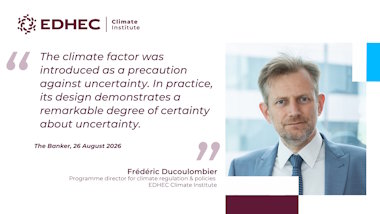
ECB’s Climate Factor Blurs Line Between Prudence and Policy
In this op-ed published in The Banker (Financial Times), Frédéric Ducoulombier examines the ECB’s new climate factor, which applies an additional collateral haircut to address forward-looking climate transition uncertainty. He questions its exclusive focus on transition risk, reliance on a single directional scenario, and use of a climate score originally designed to tilt corporate bond purchases. He argues that a genuinely prudential approach should assess financial losses across multiple plausible scenarios and transmission channels; otherwise, the measure may blur the line between financial risk management and an allocative climate policy tool.
|
|
EDHEC Events
Pricing Climate Risk: Science, Data & Fintech in Action | 8 October (Paris)
French Fintech Week 2026
Beyond Risk Diagnosis: Making Adaptation and Resilience Investable | 3 November (Paris)
Paris Infra Week 2026
Art & Climate | 10 November (Nice)
Œuvres humaines, climats changeants
|
|
|
|

|
|
About EDHEC Climate Institute:
Reflecting EDHEC Business School's strategic commitment to making climate finance a core pillar of its Generations 2050 plan, the EDHEC Climate Institute (ECI) advances the School's ambition to promote investment models aligned with climate challenges. ECI's mission is to help private and public decision-makers manage climate-related financial risks and make the most of financial tools to support the transition to a low-emission economy that is more resilient to climate change. It has a long track record as an independent and critical reference centre in helping long-term investors to understand and manage the financial implications of climate change on asset prices and the management of investments and climate action policies. The institute has also developed an expertise in physical risks, developing proprietary research frameworks and innovative approaches. ECI is also conducting advanced research on climate transition risks, with a focus on supply chain emissions (Scope 3), consumer choices, and emerging technologies. As part of its mission, ECI collaborates with academic partners, businesses, and financial players to establish targeted research partnerships. This includes making research outputs, publications, and data available in open source to maximise impact and accessibility.
|
|