| From Physical Risks to Financial Impacts |
| Forward to a colleague |
|
Subscribe to our newsletter |
 |
The EDHEC Climate Institute (ECI) supports finance professionals and decision-makers in navigating the challenges of climate change through cutting-edge research and practical tools. Our work focuses on six key areas: Physical Risks, Transition Risks, Resilience & Transition Technologies, Climate Scenarios, Green Assets, and Climate Regulation & Policies.
|
|

|
|
FEATURE
Climate Risk in Financial Markets: A Quantitative Framework
The article examines how climate change increasingly affects financial markets through slower economic growth, rising uncertainty, and changing investor expectations. Using a climate-finance framework, the authors analyse the combined effects of physical damages, transition costs, and climate-driven volatility on asset pricing. Under a 3°C warming scenario, the model projects a 15–25% rise in the equity risk premium alongside lower real risk-free rates and declining valuation multiples for risky assets. The study highlights the limits of traditional backward-looking models and stresses the importance of forward-looking climate-aware tools for investors and policymakers facing growing macro-financial risks.
|
|
INSIGHTS
Climate Change Damage to Global Railway Networks: Going off the Rails
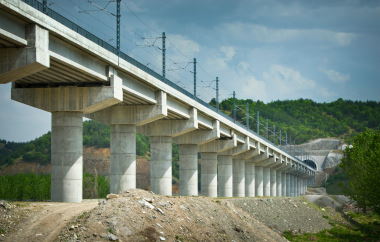
The article explores how climate change is increasingly threatening global railway infrastructure through floods, heatwaves, landslides, coastal erosion, wildfires, and permafrost thaw. It highlights how many rail systems were designed for historical climate conditions and are now operating beyond their resilience limits, leading to mounting repair costs, service disruptions, and growing safety risks. Combining case studies from Europe, North America, and Russia, the analysis shows how both acute climate shocks and chronic environmental pressures are reshaping infrastructure performance and investment needs.
|
|
|
|
|
INDICES
BNP Paribas, Euronext and Scientific Portfolio Launch Climate Resilience Index
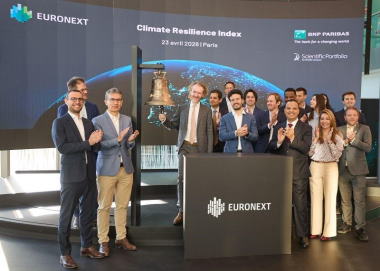
BNP Paribas CIB, Euronext, and Scientific Portfolio have launched a new Climate Resilience Index designed to integrate physical climate risk resilience into equity investment strategies, with methodological support from EDHEC Climate Institute. Combining climate resilience metrics, ESG criteria, and transition considerations, the index aims to identify companies better positioned to adapt to climate-related disruptions while remaining aligned with market performance objectives.
|
|
WEBINAR REPLAY
Climate Risk, Quantified: From Climate Data to Financial Impacts with ClimateMetrics
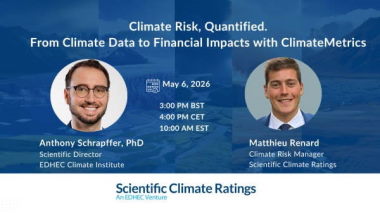
During the webinar, Anthony Schrapffer and Matthieu Renard presented ClimateMetrics, a platform developed from EDHEC Climate Institute’s research on climate financial materiality to help investors integrate climate risk into investment decision-making. Translating climate science into quantified financial metrics, the tool enables users to assess the costs of climate inaction, compare decarbonisation and resilience strategies, and evaluate climate-related impacts at both asset and portfolio level. The presentation demonstrated how transparent, science-based climate metrics can support due diligence, portfolio monitoring, financial analysis, and disclosure requirements linked to financial materiality assessments.
|
|
|

|
|
DIALOGUE
Art & Climate: Exploring the Growing Threat Climate Change Poses to Cultural Heritage
On May 4 in Paris, EDHEC Climate Institute and Campus delle Arti brought together more than 200 participants to examine how climate change increasingly threatens cultural heritage and artistic transmission. Combining scientific presentations and live musical performance, the discussion highlighted the growing exposure of UNESCO World Heritage sites, artworks, historical monuments, and cultural infrastructure to floods, heatwaves, sea-level rise, and other climate-related risks. The event explored the irreversible nature of cultural loss and emphasized the importance of interdisciplinary approaches to understanding climate change not only as an environmental and economic challenge, but also as a cultural and civilizational one.
|
|
PRESS
Europe should not trade away its sustainability reporting model
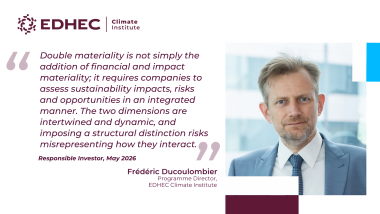
Published in Responsible Investor, the op-ed examines recent proposals to align the European Sustainability Reporting Standards (ESRS) more closely with the ISSB framework and the implications for the future of European sustainability reporting. The article argues that the proposed revisions could increase reporting complexity, create legal and operational uncertainty, and reinforce the separation between financially material and impact-related information. It also questions the implications for the integrated logic of double materiality and for the governance of the EU reporting framework. The author stresses that sustainability reporting shapes not only disclosures, but also how sustainability risks, impacts, and transition strategies are understood in practice.
|
|
|

|
|
EVENTS
Waves of Change Forum on AI for Ocean & Coastal Territories | 1-2 June (Biarritz)
Financing Coastal Resilience
FT Climate & Impact Summit 2026 | 18 June (London)
The Macroeconomic Implications of Physical Climate Risk under Uncertainty Constraints
EDHEC Climate Research Conference | 23 June (London)
Climate Risk and Business Resilience: From Science to Strategic Action
|
|

|
|
About EDHEC Climate Institute:
Reflecting EDHEC Business School's strategic commitment to making climate finance a core pillar of its Generations 2050 plan, the EDHEC Climate Institute (ECI) advances the School's ambition to promote investment models aligned with climate challenges. ECI's mission is to help private and public decision-makers manage climate-related financial risks and make the most of financial tools to support the transition to a low-emission economy that is more resilient to climate change. It has a long track record as an independent and critical reference centre in helping long-term investors to understand and manage the financial implications of climate change on asset prices and the management of investments and climate action policies. The institute has also developed an expertise in physical risks, developing proprietary research frameworks and innovative approaches. ECI is also conducting advanced research on climate transition risks, with a focus on supply chain emissions (Scope 3), consumer choices, and emerging technologies. As part of its mission, ECI collaborates with academic partners, businesses, and financial players to establish targeted research partnerships. This includes making research outputs, publications, and data available in open source to maximise impact and accessibility.
|
|