| Assessing Climate Risk in Infrastructure, Economies and Financial Markets |
| Forward to a colleague |
|
Subscribe to our newsletter |
 |
The EDHEC Climate Institute (ECI) supports finance professionals and decision-makers in navigating the challenges of climate change through cutting-edge research and practical tools. Our work focuses on six key areas: Physical Risks, Transition Risks, Resilience & Transition Technologies, Climate Scenarios, Green Assets, and Climate Regulation & Policies.
|
|

|
|
FEATURE
Mind the Carbon Gap: Full Steam Ahead to a Greener Future
Rail is already among the most energy-efficient and low-carbon transport modes, yet significant opportunities remain to further reduce emissions and strengthen resilience to climate change. This article highlights key pathways to greener rail infrastructure, including electrification, low-carbon fuels, renewable energy integration and more efficient rolling stock. It also examines how climate risks such as flooding, heat and wildfires threaten rail networks, and how targeted adaptation strategies can protect infrastructure, operations and long-term investment value.
|
|
REPLAY
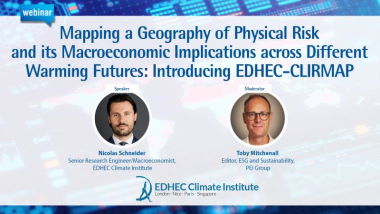
Webinar - Projecting Climate-Induced Economic Damages with EDHEC-CLIRMAP
In this webinar, Nicolas Schneider presents EDHEC-CLIRMAP, the EDHEC Climate-Induced Regional Macroimpacts Projector, an interactive online tool offering a highly granular visualisation of projected climate-induced macroeconomic damages. Covering more than 3,660 subnational regions worldwide, the platform enables users to explore localised economic impacts across different climate models, warming scenarios and time horizons throughout the 21st century.
|
|
|
|
|
PUBLICATION
Quantifying Climate Risk Premia
This working paper develops a framework to analyse how climate change affects asset prices and risk premia. It integrates a climate module into a long-run risks asset-pricing model, incorporating both physical climate damages and transition costs and calibrated using empirical damage estimates and NGFS scenarios. Results show that rising temperatures reduce the risk-free rate during rapid warming and that climate risks increase the equity risk premium, which is estimated to rise by about 20% in a 3°C warming scenario.
|
|
INSIGHTS
Climate economics isn’t broken, and the risks remain significant
The recent retraction of a key climate economics paper by Kotz et al. has raised questions about the credibility of damage estimates used by institutions such as the NGFS. However, this episode should be seen in context. Independent analyses confirm that the overall scale and direction of climate-related economic risks remain unchanged. While uncertainty persists, methodological advances and transparent scientific processes continue to strengthen climate damage assessments.
|
|

|
|
|
DATAVIZ
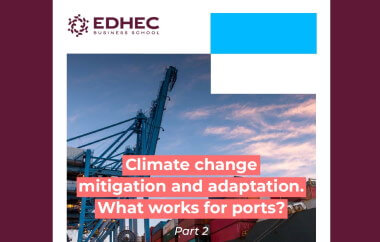
ClimaTech: What climate strategies actually work for ports?
This data visualisation, the second in a three-part ClimaTech series, explores how ports can mitigate and adapt to climate change. Drawing on the ClimaTech database, it highlights decarbonisation strategies across different emission scopes, including low-carbon fuels, renewable electricity procurement and shore power for ships at berth. It also examines resilience measures addressing key physical risks such as flooding, storms, heat and wildfires. Together, these insights illustrate how targeted technologies and infrastructure upgrades can help ports reduce emissions while strengthening climate resilience.
|
|
PRESS
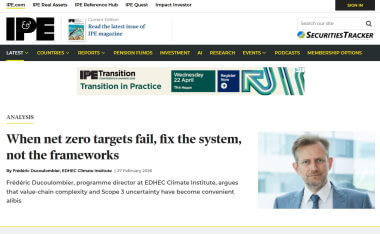
When net zero targets fail, fix the system, not the frameworks
In this column, Frédéric Ducoulombier examines the growing contestation of corporate decarbonisation targets and questions whether recent setbacks signal a retreat from climate ambition. He argues that the issue is less about abandonment of targets than about the friction between corporate commitments and structural constraints in value chains and energy systems. The piece highlights the need for stronger policy frameworks and systemic transformation, while urging investors to assess transition credibility beyond headlines and support transition-enabling reforms.
|
|
|

|
|
EVENTS
The EDHEC Climate Institute will host and contribute to several upcoming events exploring climate risk, infrastructure resilience and the energy transition:
ChangeNOW 2026 | 30–31 March (Paris)
Coastal Resilience: From Science to Solutions & Financing
Art & Climat | 4 May (Paris)
Œuvres humaines, climats changeants
“Un futur sous tension : comment bâtir une énergie résiliente et souveraine ?” | 19 May (Paris)
Évaluer la résilience des infrastructures face au climat
ILB 19th Financial Risks International Forum | 23 June (Paris)
Quantifying Climate Risk Premia
EDHEC Climate Research Conference | 23 June (London)
Climate Risk and Business Resilience: From Science to Strategic Action
|
|

|
|
About EDHEC Climate Institute:
Reflecting EDHEC Business School's strategic commitment to making climate finance a core pillar of its Generations 2050 plan, the EDHEC Climate Institute (ECI) advances the School's ambition to promote investment models aligned with climate challenges. ECI's mission is to help private and public decision-makers manage climate-related financial risks and make the most of financial tools to support the transition to a low-emission economy that is more resilient to climate change. It has a long track record as an independent and critical reference centre in helping long-term investors to understand and manage the financial implications of climate change on asset prices and the management of investments and climate action policies. The institute has also developed an expertise in physical risks, developing proprietary research frameworks and innovative approaches. ECI is also conducting advanced research on climate transition risks, with a focus on supply chain emissions (Scope 3), consumer choices, and emerging technologies. As part of its mission, ECI collaborates with academic partners, businesses, and financial players to establish targeted research partnerships. This includes making research outputs, publications, and data available in open source to maximise impact and accessibility.
|
|