| Climate Risk: From Measurement to Market Decisions |
| Forward to a colleague |
|
Subscribe to our newsletter |
 |
The EDHEC Climate Institute (ECI) supports finance professionals and decision-makers in navigating the challenges of climate change through cutting-edge research and practical tools. Our work focuses on six key areas: Physical Risks, Transition Risks, Resilience & Transition Technologies, Climate Scenarios, Green Assets, and Climate Regulation & Policies.
|
|

|
|
FEATURE
Global or Local? Why Measuring Climate Damages Matters for Investors
Drawing on EDHEC Climate Institute’s position paper “The Global Versus Local Identification of Macroeconomic Damages: Signal, Assumptions, Uncertainty”, this synthesis note examines the debate sparked by Bilal and Känzig’s 2026 study, which argues that global temperature variation may reveal substantially larger macroeconomic damages from climate change than traditional local-temperature approaches suggest. While acknowledging the importance of capturing systemic climate shocks and cross-border transmission effects, ECI highlights the continued value of granular, spatially explicit methodologies for assessing physical climate risk. The analysis underscores the trade-off between estimating aggregate global damages and preserving the regional, sectoral, and adaptation-related heterogeneity increasingly required by investors and scenario users.
|
|
INSIGHTS
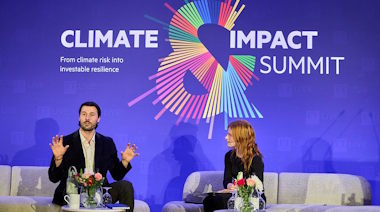
From Climate Risk to Investable Resilience: Key Highlights from the Financial Times Climate & Impact Summit
At the Financial Times Climate & Impact Summit 2026 in London, EDHEC Climate Institute contributed to discussions on how climate risk is becoming an increasingly material driver of investment and economic decision-making. Through keynote interviews and panel discussions, the Institute showcased its latest research on climate risk quantification, sector-specific macroeconomic damages, and the translation of physical climate risks into financially meaningful metrics. The discussions highlighted the growing need for granular, decision-grade climate intelligence to support resilience investments, improve risk pricing, and strengthen long-term capital allocation in an increasingly uncertain world.
|
|
|
|
|
PUBLICATION
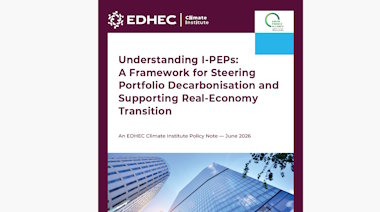
Understanding I-PEPs: A Framework for Steering Portfolio Decarbonisation and Supporting Real-Economy Transition
This policy note examines the Indicators for Portfolio-related Emission Performance (I-PEPs), a new framework developed by the Green Finance Alliance to help financial institutions steer portfolio decarbonisation more effectively. Moving beyond traditional financed-emissions metrics, I-PEPs focus on year-on-year changes in emissions performance, aiming to provide a clearer link between portfolio management and real-economy decarbonisation outcomes. The note explains the conceptual foundations, methodology, and target-setting approach of the framework, highlighting its potential to improve climate-related portfolio steering while supporting long-term transition objectives for investors, lenders, insurers, and asset managers.
|
|
INTERVIEW
What Sets Us Apart: Independence, Academic Rigor and Investor Focus
Ahead of the EDHEC Climate Research Conference 2026, held during London Climate Action Week, Camille Angué, Director of the EDHEC Climate Institute, discusses the growing recognition of climate change as a short-term macroeconomic and financial risk. She explains how increasing climate volatility, physical shocks, and evolving investor expectations are driving demand for more sophisticated climate-risk assessment tools. The interview highlights ECI’s work on physical risk modelling, climate scenarios, and climate-finance analytics, as well as its ambition to bridge academic research and practical solutions. Looking ahead, Camille argues that identifying resilient assets and adaptation opportunities will become a key driver of investment performance and capital allocation.
|
|

|

|
|
DIALOGUE
A New World Order: Businesses Facing the Challenges of Energy, Resilience and Sovereignty
On 19 May in Paris, nearly 200 participants gathered at EDHEC Business School for a conference exploring the growing interconnection between climate change, energy security, and geopolitical instability. During the discussions, EDHEC Climate Institute highlighted how climate risks increasingly act as a multiplier of economic and strategic vulnerabilities, creating cascading effects across critical infrastructure, supply chains, and financial systems. The Institute also presented research on the rising exposure of infrastructure assets to physical climate risks and its ambition to develop a global climate resilience rating framework. The event underscored the need for decision-makers to integrate climate, energy, and geopolitical risks into investment and governance strategies.
|
|
PRESS
When a Governance Test Becomes a Test of Governance Model
Published in Sustainable Views (Financial Times), this op-ed examines the governance questions raised by the anticipated SpaceX IPO and their implications for sustainable investment funds. While environmental and social assessments may remain open to interpretation, the article argues that SpaceX’s governance structure presents clear challenges under the “good governance” requirements of the Sustainable Finance Disclosure Regulation (SFDR). The analysis highlights the responsibilities of fund managers to apply governance methodologies consistently, transparently, and in line with investor commitments, even when commercially attractive opportunities are at stake. More broadly, it argues that governance frameworks are ultimately tested when their conclusions become inconvenient.
|
|

|
|
|
LAUNCH
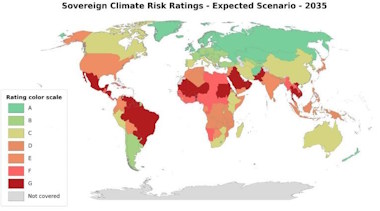
Sovereign Climate Risk Ratings set a new standard for assessing climate risk's impact on GDP
Unveiled at the EDHEC Climate Research Conference 2026, Scientific Climate Ratings’ new Sovereign Climate Risk Ratings build on EDHEC Climate Institute’s research to quantify the long-term macroeconomic impacts of chronic physical climate risk across 191 countries and more than 3,400 subnational regions. The framework translates regional climate damages into forward-looking sovereign ratings, ranging from A to G, enabling investors, asset managers, and banks to assess sovereign exposure under multiple climate scenarios. The initiative demonstrates how EDHEC Climate Institute’s research is being transformed into practical tools for climate-informed investment and sovereign risk analysis.
|
|

|
|
About EDHEC Climate Institute:
Reflecting EDHEC Business School's strategic commitment to making climate finance a core pillar of its Generations 2050 plan, the EDHEC Climate Institute (ECI) advances the School's ambition to promote investment models aligned with climate challenges. ECI's mission is to help private and public decision-makers manage climate-related financial risks and make the most of financial tools to support the transition to a low-emission economy that is more resilient to climate change. It has a long track record as an independent and critical reference centre in helping long-term investors to understand and manage the financial implications of climate change on asset prices and the management of investments and climate action policies. The institute has also developed an expertise in physical risks, developing proprietary research frameworks and innovative approaches. ECI is also conducting advanced research on climate transition risks, with a focus on supply chain emissions (Scope 3), consumer choices, and emerging technologies. As part of its mission, ECI collaborates with academic partners, businesses, and financial players to establish targeted research partnerships. This includes making research outputs, publications, and data available in open source to maximise impact and accessibility.
|
|