| Understanding Climate Risk: From Physical Impacts to Future Scenarios |
| Forward to a colleague |
|
Subscribe to our newsletter |
 |
| The EDHEC Climate Institute (ECI) supports finance professionals and decision-makers in navigating the challenges of climate change through cutting-edge research and practical tools. Our work focuses on six key areas: Physical Risks, Transition Risks, Resilience & Transition Technologies, Climate Scenarios, Green Assets, and Climate Regulation & Policies. |
|
|
|
FEATURE
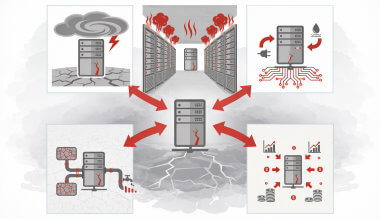
Protection, Adaptation, Evaluation - The Fast-Changing Financial Climate Risk Overhanging Data Infrastructure
This article explores the rapidly evolving physical and transition climate risks facing data infrastructure assets, particularly data centres. Extremely sensitive to heat, power and water disruptions, the sector is exposed to significant value erosion under severe climate scenarios. Drawing on EDHEC’s ClimaTech research, the article highlights how extreme weather, interdependencies with energy and water networks, and tightening decarbonisation constraints reshape risk profiles, while offering investors robust tools to assess resilience, transition strategies and long-term infrastructure vulnerability.
|
|
NEWS
EDHEC Climate Institute and Waves of Change Form a Partnership to Support Climate Resilience of Coastal Territories
EDHEC Climate Institute and Waves of Change have announced a new partnership to strengthen climate resilience in coastal territories. The collaboration integrates EDHEC’s climate risk research and tools into Waves of Change’s Coastal Cities Impact Facility and Live Knowledge Hub, supporting applied projects, knowledge dissemination and the Coastal Resilience Chair. Together, the partners aim to translate climate science into concrete, finance-ready solutions for coastal infrastructure and cities.
|
|
|
|
|
RETROSPECTIVE
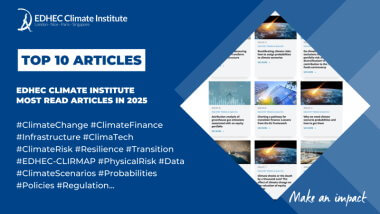
What Shaped Climate-Aware Finance in 2025? EDHEC’s Most-Read Articles
Our most-read publications in 2025 reflect three core priorities: developing granular tools to assess transition and physical risks at the asset and regional level; strengthening scenario analysis and valuation frameworks through probabilistic approaches; and critically examining how sustainable finance regulation, from disclosures to transition finance, can better support real-economy decarbonisation and resilience. As we begin 2026, we look back at the Top 10 most-read articles of 2025, covering infrastructure resilience, equity valuation, climate scenarios, coastal risk, carbon footprints and the evolving policy frameworks shaping climate-aware finance.
|
|
PUBLICATION
Physical Climate Risk in the European Equity Market: Quantifying Country – Sector Heterogeneity
This white paper, co-published with Scientific Portfolio, presents a transparent, scenario-based framework to quantify physical climate risk in European equity markets. Using NGFS scenarios and publicly available data, it links country-level climate damages to firm and portfolio valuations through a discounted cash-flow approach. Applied to 423 European firms, the analysis reveals strong country and sector heterogeneity, with an estimated physical climate loss of around -4.7% for a diversified Europe equity benchmark.
|
|
|

|
|
DATAVIZ
ClimaTech: A World-First Climate Asset Lens
Climate change is already disrupting infrastructure, as key assets are exposed to both physical and transition risks. Yet existing tools often remain too generic to capture sector-specific and geographical vulnerabilities or to support effective strategies. This is why EDHEC Climate Institute has developed ClimaTech, an innovative, science-based platform offering a comprehensive matrix of climate-related risks across the infrastructure value chain. This first carousel introduces the platform and illustrates how these risks can be explored and compared. Discover this new data visualisation (ClimaTech, part 1).
|
|
INSIGHT
How Hot Will It Get? EDHEC-EXCITE: A New Way to Explore Climate Futures
This article introduces EDHEC-EXCITE, EDHEC Climate Institute’s new temperature emulator designed to make climate futures more transparent and accessible. By linking user-defined or existing emissions pathways to a wide range of climate models, the tool openly represents uncertainty around climate sensitivity. It combines scientific rigour with intuitive visuals, helping policymakers, investors and regulators better understand how today’s emissions choices shape future warming trajectories.
|
|

|
|

|
|
About EDHEC Climate Institute:
Reflecting EDHEC Business School's strategic commitment to making climate finance a core pillar of its Generations 2050 plan, the EDHEC Climate Institute (ECI) advances the School's ambition to promote investment models aligned with climate challenges. ECI's mission is to help private and public decision-makers manage climate-related financial risks and make the most of financial tools to support the transition to a low-emission economy that is more resilient to climate change. It has a long track record as an independent and critical reference centre in helping long-term investors to understand and manage the financial implications of climate change on asset prices and the management of investments and climate action policies. The institute has also developed an expertise in physical risks, developing proprietary research frameworks and innovative approaches. ECI is also conducting advanced research on climate transition risks, with a focus on supply chain emissions (Scope 3), consumer choices, and emerging technologies. As part of its mission, ECI collaborates with academic partners, businesses, and financial players to establish targeted research partnerships. This includes making research outputs, publications, and data available in open source to maximise impact and accessibility.
|
|