| Mapping Physical Climate Risk and Its Economic Implications |
| Forward to a colleague |
|
Subscribe to our newsletter |
 |
| The EDHEC Climate Institute (ECI) supports finance professionals and decision-makers in navigating the challenges of climate change through cutting-edge research and practical tools. Our work focuses on six key areas: Physical Risks, Transition Risks, Resilience & Transition Technologies, Climate Scenarios, Green Assets, and Climate Regulation & Policies. |
|
|
|
FEATURE
Before They Materialise: Global Physical Risk Hotspots
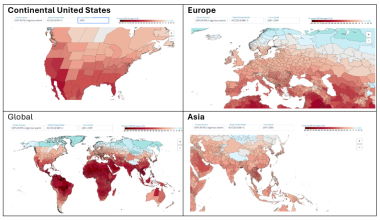
Climate risk assessments often rely on national or global aggregates, which can mask the underlying drivers of economic losses and create a false sense of stability. Focusing on North America, Europe and Asia, this analysis uses EDHEC-CLIRMAP to identify physical climate risk hotspots where economic losses are expected to be severe, alongside regions that may temporarily benefit from warming. Coastal, low-latitude and highly urbanised areas emerge as clear losers, while some higher-latitude or inland regions appear more resilient or even experience positive outcomes. By highlighting these regional winners and losers, the article shows why climate risk is fundamentally spatial and why investors need granular, region-level insights to anticipate material impacts on assets and portfolios.
|
|
EVENT
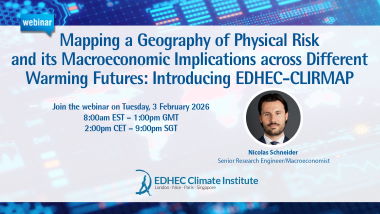
Webinar - Mapping a Geography of Physical Risk and its Macroeconomic Implications Across Different Warming Futures: Introducing EDHEC-CLIRMAP
How does climate change–driven temperature shift affect regional economies? To address this question, the EDHEC Climate Institute is hosting a webinar introducing EDHEC-CLIRMAP, a new interactive platform projecting climate-induced macroeconomic damages at unprecedented regional resolution. Presented by Nicolas Schneider (ECI) and moderated by Toby Mitchenall (PEI) the session explains the modelling framework combining high-resolution climate data, macroeconomic analysis, and climate econometrics, and explores how insights across climate scenarios can inform financial analysis, policy planning, and long-term risk management.
|
|
|

|
|
INTERVIEW
EDHEC-CLIRMAP Shows a Geography of Physical Risk and its Macroeconomic Implications Across Different Warming Futures
In this interview, Nicolas Schneider, Senior Research Engineer/Macroeconomist, presents EDHEC-CLIRMAP. This groundbreaking interactive online tool is the first to ever provide a high-resolution geographic visualisation of potential future macroeconomic damages driven by climate change. EDHEC-CLIRMAP illustrates a projected future, but not an inevitable one: a future that still depends in part on the choices we make today. It also highlights the importance of funding regionally informed adaptation strategies, as the tool identifies areas where net winners and losers, in absolute terms, may emerge.
|
|
PUBLICATION
The Global Geography of Long-Term Projected Macroeconomic Damages from Chronic Physical Climate Risk: Country vs. Intra-Country Distribution
This working paper analyses how countries and subnational regions respond economically to annual temperature and precipitation fluctuations using data from 1970–2018. By combining econometric estimates with CMIP6 climate simulations across 3,672 provinces, it projects substantial end-of-century GDP losses-up to 70% from temperature-driven chronic physical climate risk, especially in tropical regions under SSP5-8.5. The study highlights how granular climate and economic heterogeneity significantly reshapes global damage estimates.
|
|
|

|
|
INSIGHT
From Global Average to Local Insights: Harnessing High-Resolution Data for Climate Risk Assessment and Resilience to Physical Shocks
Climate change impacts are highly localised, yet financial models often rely on global averages that obscure sector- and region-specific risks. We explore how high-resolution climate data can enhance risk assessments by pinpointing geo-sectorial vulnerabilities, enabling investors, businesses, and cities to develop targeted adaptation strategies.
|
|

|
|
About EDHEC Climate Institute:
Reflecting EDHEC Business School's strategic commitment to sustainability and climate finance, the EDHEC-Risk Climate Impact Institute has evolved into the EDHEC Climate Institute (ECI), consolidating the School's expertise in climate-related financial research and decision-making. ECI's mission is to help private and public decision-makers manage climate-related financial risks and make the most of financial tools to support the transition to a low-emission economy that is more resilient to climate change. It has a long track record as an independent and critical reference centre in helping long-term investors to understand and manage the financial implications of climate change on asset prices and the management of investments and climate action policies. The institute has also developed an expertise in physical risks, developing proprietary research frameworks and innovative approaches. ECI is also conducting advanced research on climate transition risks, with a focus on supply chain emissions (Scope 3), consumer choices, and emerging technologies. As part of its mission, ECI collaborates with academic partners, businesses, and financial players to establish targeted research partnerships. This includes making research outputs, publications, and data available in open source to maximise impact and accessibility.
|
|