Climate Risk in an Uncertain World:
From Physical Impacts to Financial and Policy Decisions |
| Forward to a colleague |
|
Subscribe to our newsletter |
 |
The EDHEC Climate Institute (ECI) supports finance professionals and decision-makers in navigating the challenges of climate change through cutting-edge research and practical tools. Our work focuses on six key areas: Physical Risks, Transition Risks, Resilience & Transition Technologies, Climate Scenarios, Green Assets, and Climate Regulation & Policies.
|
|
|
|
FEATURE
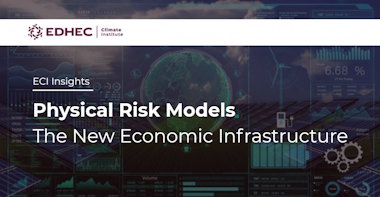
Why Climate Models Are Becoming Critical Economic Infrastructure
This article uses Europe’s 2026 wildfire season to illustrate a broader challenge: translating increasingly volatile physical climate hazards into meaningful economic and financial information. It explores how climate projections, physical models, satellite observations and damage functions can help identify where risks are concentrated and how they affect assets and economic activity. As climate change makes geography increasingly important, these tools can support investment decisions, distinguish vulnerable from resilient assets, and help allocate adaptation capital where it can preserve the greatest long-term value.
|
|
NEW ECI BLOG
Expert Perspectives on Climate Risk and Resilience
Our new ECI Blog brings together timely perspectives from EDHEC Climate Institute experts on emerging climate challenges. Mélodie Trolliet examines the economic risks of increasingly severe heatwaves; Frédéric Ducoulombier explores insurance pricing and the limits of energy diversification; Anthony Schrapffer makes the financial case for climate-resilient infrastructure; and Alessandra Treviso shows how ClimaTech can help prioritise effective resilience strategies. Selected contributions are available for republication by media, extending these expert insights to a wider audience.
|
|

|

|
|
INITIATIVE
Wildfire Risk: Two New Initiatives for Prevention and Response
Launched on June 30, just as a summer of severe wildfires was beginning across Europe and beyond, two complementary initiatives from the EDHEC Climate Institute and Climate Innov aim to strengthen wildfire prevention and response. ensemblepourlaforet.fr provides free, hour-by-hour wildfire ignition risk forecasts across metropolitan France, at 3 km resolution and up to 36 hours ahead. SecuFire Action, available free to public authorities, combines weather, vegetation, topography, satellite data and the validated Balbi fire spread model to project wildfire evolution within seconds, compared with close to two hours using conventional processes, and support decisions on evacuations, infrastructure protection and firefighting resource deployment. For the EDHEC Climate Institute, whose mission is to support decision-making in the face of major climate challenges, funding these initiatives reflects a tangible commitment to risk prevention and the protection of communities and territories.
|
|
PUBLICATION
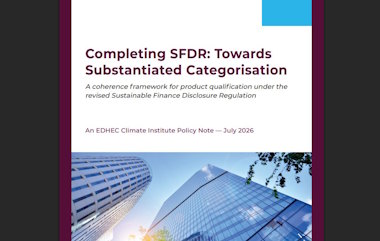
Completing SFDR: Towards Substantiated Categorisation
This policy note examines the EU’s proposed reform of the Sustainable Finance Disclosure Regulation (SFDR) and the shift towards a product categorisation regime. It argues that sustainability categories should go beyond formal eligibility criteria and require investment strategies to substantiate how they can contribute to real-economy transition. Comparing proposals from the European Commission, Parliament and Council, the note calls for coherent qualification standards, greater transparency, and a stronger link between product objectives, investment processes and measurable sustainability outcomes.
|
|
|

|
|
INTERVIEW
Why Understanding Climate Scenarios Matters for Investors and Policymakers
This interview examines how climate scenarios should be interpreted and used for decision-making, following renewed debate around the high-emissions SSP5-8.5 pathway. Lionel Melin explains why scenarios are exploratory tools rather than predictions, and why scientific usefulness should not be confused with plausibility. He explains how assigning probabilities to climate scenarios and considering the full distribution of possible outcomes, including extreme tail risks, can provide investors, insurers and policymakers with a more robust basis for making decisions under climate uncertainty. This probabilistic approach is central to ECI’s climate scenarios research.
|
|
PODCAST
Physical Climate Risk: From Climate Science to Financial Materiality
This podcast, recorded with PEI Group’s New Private Markets, explores how physical climate risk translates into economic and financial impacts for institutional investors. Nicolas Schneider explains why investors need to look beyond extreme weather events to the cumulative effects of chronic, compounding climate risks. He discusses why these risks may not yet be fully reflected in asset valuations, how EDHEC-CLIRMAP captures their economic impacts across regions and warming scenarios, and the implications for portfolio exposure and long-term investment decisions.
|
|

|
|
|
COMMENT
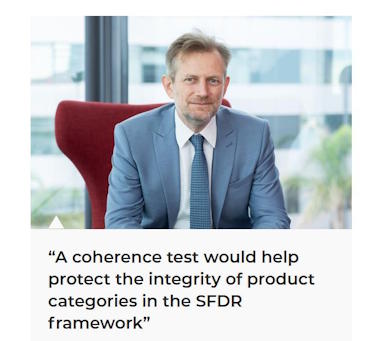
When a Credible SFDR Framework Needs More Than Category Criteria
In his second column for Investment & Pensions Europe (IPE), Frédéric Ducoulombier examines the EU’s proposed shift from sustainability disclosure towards product categorisation under SFDR. He argues that minimum qualification criteria alone cannot ensure credible sustainability claims. Products should also demonstrate coherence between their stated objectives, investment strategies, implementation mechanisms and performance indicators. Such process-based substantiation, alongside greater transparency, could strengthen product categories, reduce greenwashing risks and clarify what finance can realistically contribute to the transition of the real economy.
|
|
PRESS
SEC's Climate Disclosure Rollback is Not a Return to Materiality
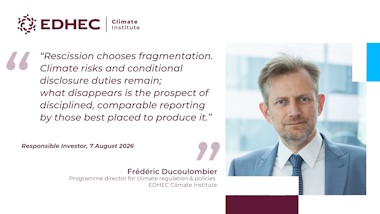
In this Responsible Investor op-ed, Frédéric Ducoulombier examines the SEC’s proposed rescission of its 2024 climate-disclosure rules. He argues that the debate is not about whether materiality should apply, but whether material climate risks should be reported through a common framework or addressed issuer by issuer. Rescission would leave climate risks and existing disclosure obligations intact while abandoning standardised reporting, potentially increasing fragmentation, reducing comparability, and leaving investors to reconstruct missing climate information at significant cost.
|
|
|
|
|
NEWS
From Science to Strategic Action: Highlights from the EDHEC Climate Research Conference 2026
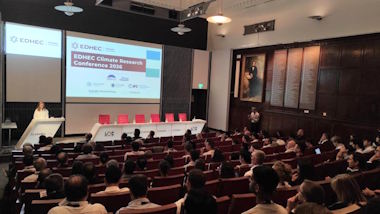
This article looks back at the inaugural EDHEC Climate Research Conference, held during London Climate Action Week, which brought together over 200 participants, including researchers, investors and policymakers. Discussions covered probabilistic climate scenarios, granular physical-risk modelling through CLIRMAP, resilience and decarbonisation strategies through ClimaTech, and forward-looking transition-risk analysis. The conference also saw the unveiling of Scientific Climate Ratings’ Sovereign Climate Risk Rating, illustrating how EDHEC research is being translated into practical tools for climate-informed financial decision-making.
|
|

|
|
About EDHEC Climate Institute:
Reflecting EDHEC Business School's strategic commitment to making climate finance a core pillar of its Generations 2050 plan, the EDHEC Climate Institute (ECI) advances the School's ambition to promote investment models aligned with climate challenges. ECI's mission is to help private and public decision-makers manage climate-related financial risks and make the most of financial tools to support the transition to a low-emission economy that is more resilient to climate change. It has a long track record as an independent and critical reference centre in helping long-term investors to understand and manage the financial implications of climate change on asset prices and the management of investments and climate action policies. The institute has also developed an expertise in physical risks, developing proprietary research frameworks and innovative approaches. ECI is also conducting advanced research on climate transition risks, with a focus on supply chain emissions (Scope 3), consumer choices, and emerging technologies. As part of its mission, ECI collaborates with academic partners, businesses, and financial players to establish targeted research partnerships. This includes making research outputs, publications, and data available in open source to maximise impact and accessibility.
|
|