| Mapping Climate Risk: New Insights Across Infrastructure, Markets and Policy |
| Forward to a colleague |
|
Subscribe to our newsletter |
 |
The EDHEC Climate Institute (ECI) supports finance professionals and decision-makers in navigating the challenges of climate change through cutting-edge research and practical tools. Our work focuses on six key areas: Physical Risks, Transition Risks, Resilience & Transition Technologies, Climate Scenarios, Green Assets, and Climate Regulation & Policies.
|
|
|
|
FEATURE
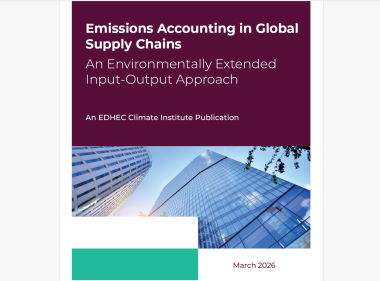
Emissions Accounting in Global Supply Chains: An Environmentally Extended Input-Output Approach
This new report provides a comprehensive framework for measuring greenhouse gas emissions across global supply chains using Environmentally Extended Input-Output (EEIO) models. It explains how economic and environmental data can be combined to capture direct and indirect emissions, including Scope 1, 2 and 3 equivalents at sector level. Applied globally, the approach highlights the central role of supply chains and trade in shaping carbon footprints, while discussing methodological strengths, limitations, and implications for policy and corporate reporting.
|
|
INSIGHTS
Weather Risk, Market Response: Measuring Climate Betas Across Commodity Systems
The article examines how weather variability and climate signals increasingly shape commodity markets by affecting production, demand, and logistics. It highlights the role of sub-seasonal and seasonal forecasts, weather regimes, and alternative data in anticipating market movements. By linking physical climate dynamics to price formation, the authors show how traders integrate these signals into risk management, pricing, and scenario modelling in a context of growing climate uncertainty and structural climate change impacts on markets.
|
|

|
|
|
PUBLICATION
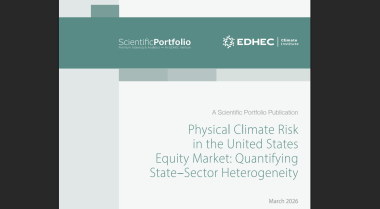
Physical Climate Risk in the United States Equity Market: Quantifying State–Sector Heterogeneity
This publication presents a scenario-based framework to quantify physical climate risk for U.S. listed firms and equity portfolios. By integrating macroeconomic damage projections into a discounted cash-flow model, it estimates how climate-induced losses affect firm valuations. Applied to 500 large U.S. companies, the results reveal significant variation in exposure across states and sectors, with projected GDP losses ranging widely and a portfolio-level impact of around -4.0% under current policies. The framework, based on publicly available data, offers a transparent and practical tool for assessing climate risk and informing strategic asset allocation.
|
|
DATAVIZ
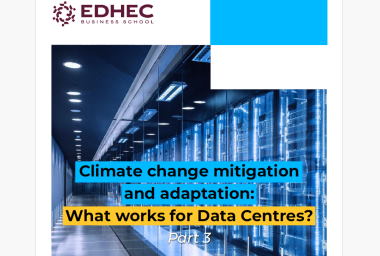
Climate Change Mitigation and Adaptation: What Works for Data Centres?
This data visualisation, the last in a three-part ClimaTech series, explores how data centres can mitigate climate change and adapt to its physical risks. Drawing on the ClimaTech database, it highlights key decarbonisation strategies across Scope 1, 2 and 3 emissions, as well as technologies supporting these efforts. It also examines resilience measures against major climate risks, including floods, storms, heat and wildfires, showing varying levels of effectiveness. It provides a structured overview of how technological solutions can support both emissions reduction and climate adaptation in critical digital infrastructure.
|
|
|

|
|
PRESS
SFDR reform: from compliance to coherence
Published in Sustainable Views and The Banker, the article argues that the proposed revision of the Sustainable Finance Disclosure Regulation (SFDR) risks increasing the very greenwashing it seeks to address. While SFDR has improved transparency, it remains complex and confusing for investors. The reform introduces streamlined disclosures and product categories backed by eligibility rules, but its composition-based logic does not ensure a credible link between sustainability objectives, investment strategies, and support for the transition. The author calls for a coherence test across all sustainability-labelled products, warning that without it, approaches focused on portfolio arrangements may be treated as equivalent to those delivering real-economy outcomes.
|
|
EVENTS
Art & Climat | 4 May (Paris)
Œuvres humaines, climats changeants
UNEP FI & PRI Roundtable | 7 May (Zurich)
Transition Planning & Financing in the Financial Sector
“Un futur sous tension : comment bâtir une énergie résiliente et souveraine ?” | 19 May (Paris)
Évaluer la résilience des infrastructures face au climat
Waves of Change Forum on AI for Ocean & Coastal Territories | 1-2 June (Biarritz)
Financing Coastal Resilience
FT Climate & Impact Summit 2026 | 18 June (London)
The Macroeconomic Implications of Physical Climate Risk under Uncertainty Constraints
EDHEC Climate Research Conference | 23 June (London)
Climate Risk and Business Resilience: From Science to Strategic Action
|
|

|
|

|
|
About EDHEC Climate Institute:
Reflecting EDHEC Business School's strategic commitment to making climate finance a core pillar of its Generations 2050 plan, the EDHEC Climate Institute (ECI) advances the School's ambition to promote investment models aligned with climate challenges. ECI's mission is to help private and public decision-makers manage climate-related financial risks and make the most of financial tools to support the transition to a low-emission economy that is more resilient to climate change. It has a long track record as an independent and critical reference centre in helping long-term investors to understand and manage the financial implications of climate change on asset prices and the management of investments and climate action policies. The institute has also developed an expertise in physical risks, developing proprietary research frameworks and innovative approaches. ECI is also conducting advanced research on climate transition risks, with a focus on supply chain emissions (Scope 3), consumer choices, and emerging technologies. As part of its mission, ECI collaborates with academic partners, businesses, and financial players to establish targeted research partnerships. This includes making research outputs, publications, and data available in open source to maximise impact and accessibility.
|
|