|
|
|
|
Climate Research Highlights
Issue n°6, December 2025
|
|
Welcome to the sixth edition of EDHEC’s Climate Research Highlights, showcasing the latest research, insights, and innovations emerging from the EDHEC Climate Institute and EDHEC Ventures. This quarter, we examine the state of climate action ten years after the Paris Agreement through a landmark analysis of trust and policy credibility. We explore advancing methods for assessing coastal infrastructure risks, uncover the ethical choices embedded in climate-alignment models, and spotlight EDHEC developments such as ClimaTech and new findings featured in the Scientific Climate Ratings supplement. This edition also includes interviews, media contributions, and forthcoming events, including a webinar introducing EDHEC-CLIRMAP and the 2026 EDHEC Climate Research Conference.
|
|
|
Latest Insights
|

|
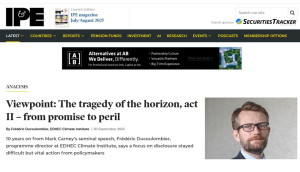
A Decade after Paris: Trust Misplaced, Trust Betrayed - and How to Rebuild It
Ten years after the Paris Agreement, this paper argues that climate progress has been constrained by a breakdown of trust. Transparency was expected to drive ambition, but insufficient policy follow-through, inadequate support for developing countries, and reliance on markets left emissions reductions and investment far off target. It outlines how trust was misplaced, betrayed, and now must be rebuilt through credible policy, institutional renewal, and citizen authorisation.
|

|
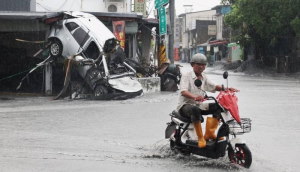
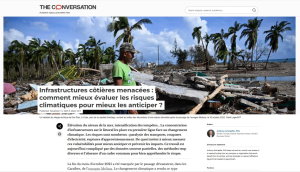
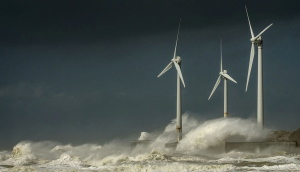
Coastal Regions and Climate Change: How Can Better Risk Assessment Help Protect Infrastructure and Livelihoods?
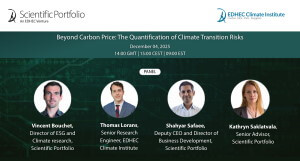
Nearly 40% of the global population lives within 100 km of the coast. Ports, cities and industrial areas depend on coastal infrastructure, yet these assets sit on the frontline of climate impacts such as flooding, storms and sea level rise. This article explores how clearer climate-risk measurement can help public and private stakeholders strengthen the resilience of critical assets. Accurately measuring these risks is the first step to making them visible, and impossible to ignore.
|

|
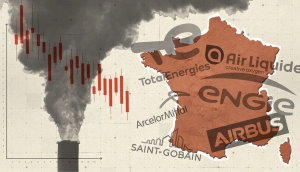
Clarifying Hidden Ethics in Climate Investing
This article presents Scientific Portfolio’s latest paper, which shows how ethical frameworks can affect methodological decisions, resulting in very different 'alignment' calculations. It outlines three ethical archetypes: principled, utilitarian, and harmonist, inviting investors to consider which best aligns with their own stance. The study then illustrates how each perspective informs model-design decisions and how these choices influence alignment outcomes for a portfolio of the 1,300 largest developed-market stocks.
|
![[#dataviz] To what extent do listed companies contribute to climate change?](https://docs.climateimpactedhec.com/highlights_dec25/insight_004b.jpg "[#dataviz] To what extent do listed companies contribute to climate change?")
|
[#dataviz] To what extent do listed companies contribute to climate change?
In fifty years, global greenhouse gas (GHG) emissions have doubled, reaching 53 gigatonnes of CO₂ equivalent in 2023. Of these emissions, 18% come directly from 5,018 publicly traded companies, which alone account for 88% of global market capitalisation. In this carousel, Vincent Bouchet (Scientific Portfolio), details his research on the carbon emissions of (large) companies, their decarbonisation targets and the revenues associated with climate solutions.
|

|
3 Questions to Nishtha Manocha (EDHEC) on the ClimaTech Project
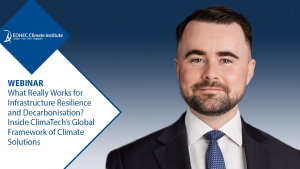
In this interview, Nishtha Manocha presents ClimaTech, which stands for “The Technology Taxonomy for Climate Resilience and Transition”. Built and supported by the EDHEC Climate Institute, ClimaTech is a world-class innovation which focuses on advancing understanding of technology-based solutions that help infrastructure assets reduce carbon emissions and enhance resilience to climate risks.
|
|
|
|
Reference Publications
|
Scientific Climate Ratings Research Insights Supplement to Investment & Pensions Europe (IPE)
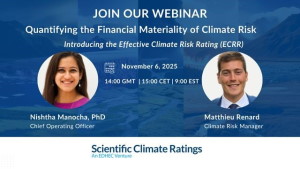
In this supplement, the authors explore how climate science can be translated into actionable financial insights. Long-term institutional investors increasingly require science-based climate ratings to evaluate the financial materiality of climate risks and quantify the asset value at stake. They introduce ClimaTech, a research-driven knowledge base dedicated to effective climate risk-reduction strategies. They also examine Scope 3, or value-chain emissions, which represent the largest share of corporate carbon footprints yet remain widely overlooked in financial reporting. Finally, they assess wildfire risks in a warming climate, highlighting the need for credible, forward-looking tools to guide resilient investment and policy decisions.
|
|
|
|
|
|
|
|
Forthcoming Events
|
|
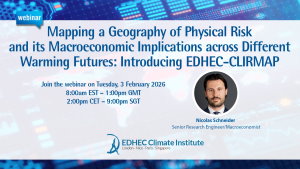
3 February – Mapping a Geography of Physical Risk and its Macroeconomic Implications across Different Warming Futures: Introducing EDHEC-CLIRMAP
Join us for a webinar introducing EDHEC-CLIRMAP, a new high-resolution tool mapping climate-driven macroeconomic damages across more than 3,600 regions worldwide. We will present the methodology behind these projections and demonstrate how users can explore impacts across climate models, warming scenarios, and future horizons. A valuable session for investors, policymakers, researchers, and anyone assessing climate-related economic risks.
|
|
|
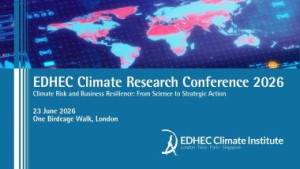
23 June - EDHEC Climate Research Conference 2026 – Climate Risk and Business Resilience: From Science to Strategic Action
On 23 June 2026, the EDHEC Climate Institute will host its inaugural Climate Research Conference in London. The event will bring together academics, regulators, investors, and industry leaders to explore how science-based tools can transform the assessment and management of climate risks. Sessions will address advances in probabilistic scenario analysis, high-resolution data modelling, and the evaluation of climate resilience strategies across sectors.
|
|
|
|
|
EDHEC Business School,
393 Promenade des Anglais, BP 3116, 06202 Nice Cedex 3, France
|
|
|